
EJEC Delivers Invited Lecture at JICA’s First Road Tunnel Technology Seminar in Bangkok
2026.3.27
On March 6, 2026, Teppei Tomita of Eight-Japan Engineering Consultants Inc. (EJEC) delivered an invited lecture at the 1st Road Tunnel Technology Seminar hosted by the Japan International Cooperation Agency (JICA) in Bangkok, Thailand. The seminar, jointly organized by JICA and the Department of Highways (DOH) of Thailand, brought together leading experts from both Japan and Thailand to share technical knowledge and case studies on environmentally responsible tunnel planning and construction.
Session Overview and Featured Speakers
The seminar featured presentations by specialists from both countries and facilitated active technical discussions throughout the day.
| Time | Topic | Speaker |
|---|---|---|
| 9:00 – 9:10 |
Opening Remarks |
— |
| 9:10 - 9:40 |
JICA’s Support for Road Tunnels |
Tsukasa Nakamura (JICA Expert, Department of Highways Thailand) |
| 9:40 - 10:40 |
Engineering Approaches in Planning and Design to Minimize Environmental Impacts |
Teppei Tomita (Eight-Japan Engineering Consultants Inc.) |
| 11:00 - 12:00 |
Environmental and Social Considerations for Tunnels in Protected Areas |
Akira Yamashita (Environment and Social Infrastructure Consultant Co., Ltd.) |
| 13:00 - 13:40 |
Rock Mechanics and Tunnel Engineering in Thailand’s Mountainous Regions |
Prof. Noppadol Phien-wej (Asian Institute of Technology) |
| 13:40 - 14:20 |
Geological Hazard Risk Management in Mountain Ecosystems |
Prof. Suttisak Soralump (Kasetsart University) |
| 14:40 - 15:40 |
Environmentally Conscious and Safe Construction of Mountain Tunnels: Japan’s Advanced Technologies and Best Practices |
Takayuki Matsumoto (Shimizu Corporation) |
| 15:40 - 16:00 |
Closing Remarks & Group Photo |
— |
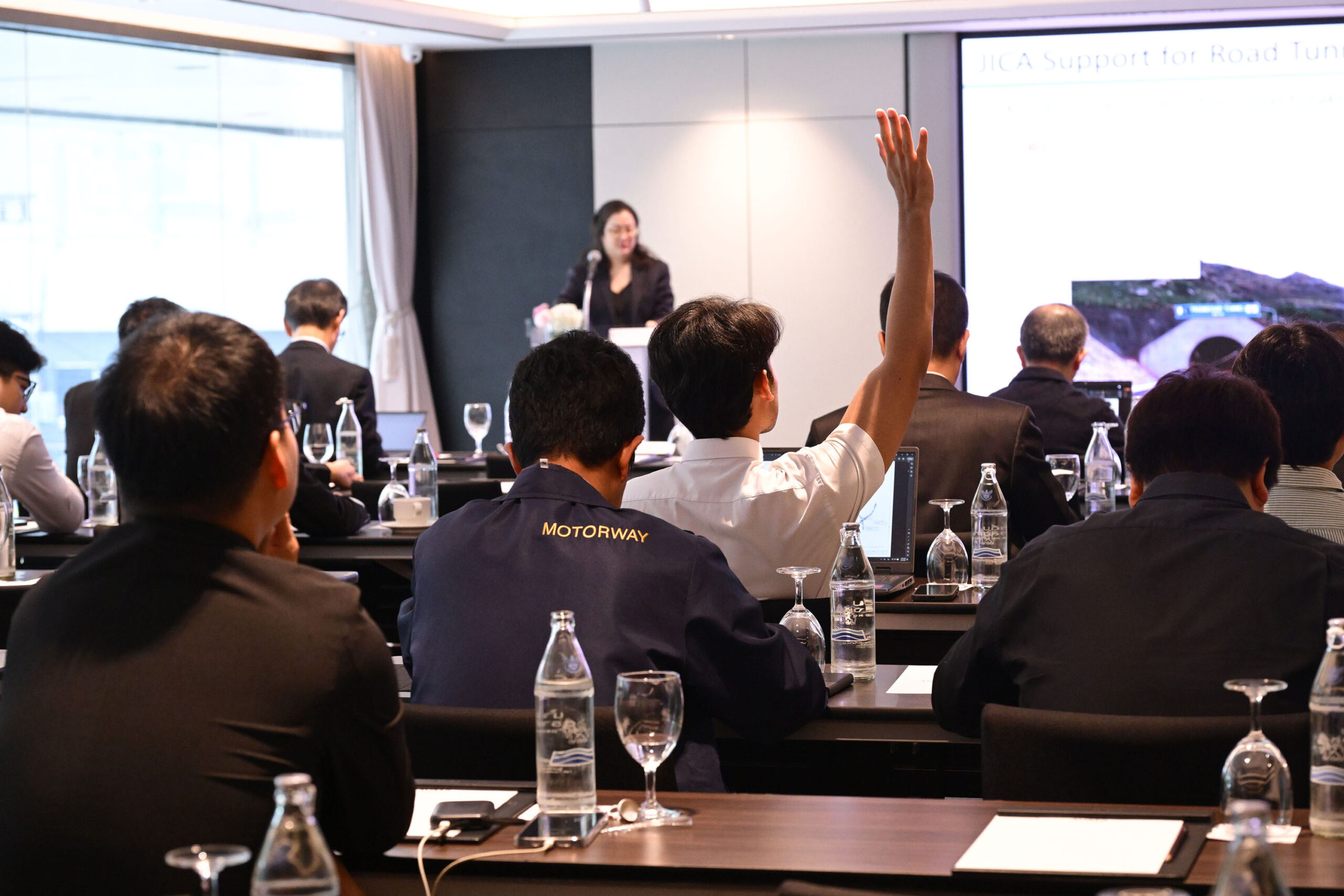
A lively Q&A session, with numerous participants actively engaging and asking questions.
A lively Q&A session, with numerous participants actively engaging and asking questions.
Overview of EJEC’s Technical Presentation
Mr. Tomita’s presentation, entitled “Engineering Approaches in Planning and Design to Minimize Environmental Impacts,” covered advanced methodologies and key environmental considerations essential for tunnel construction in ecologically sensitive areas.
| Item | Description |
|---|---|
| Core Environmental Principles |
He emphasized the fundamental environmental hierarchy of Avoidance, Minimization, and Compensation, as well as the importance of applying the Precautionary Principle when uncertainties exist regarding irreversible impacts. |
| Regulatory Frameworks and Technical Guidelines |
He introduced Japan’s five‑tier zoning system under the Natural Parks Act and its corresponding development control mechanisms. He also explained how the revised 2023 DOH Tunnel Planning Manual can be strategically utilized during project formulation. |
| Environmental Impact Mechanisms and Predictive Assessment Technologies |
The session detailed key impact factors—such as groundwater drawdown, inflow, noise and vibration, and ecological disturbance. He demonstrated the use of 3D groundwater flow modeling, advanced noise/vibration prediction, and other quantitative assessment tools. |
| Construction Techniques for Reducing Environmental Loads |
The presentation compared the environmental characteristics of major tunneling methods—including the NATM and shield tunneling methods. He highlighted techniques such as water-tight lining systems, pre‑grouting for groundwater conservation, and the effective utilization of over 90% of construction by‑products. |
| Adaptive Management Through Advanced Monitoring |
He stressed the importance of continuous monitoring during construction and operation, presenting examples of adaptive management where plans are dynamically updated based on measurement data. |
Mr. Tomita introduced a domestic case study—the use of a siphon‑type groundwater bypass system to maintain the natural flow of the renowned “Minoh Waterfall.” This strategy exemplified Japan’s advanced approach to protecting hydrological environments while implementing large‑scale infrastructure. The case attracted significant interest from Thai participants as a valuable reference for upcoming tunnel planning in Thailand’s protected areas.
-

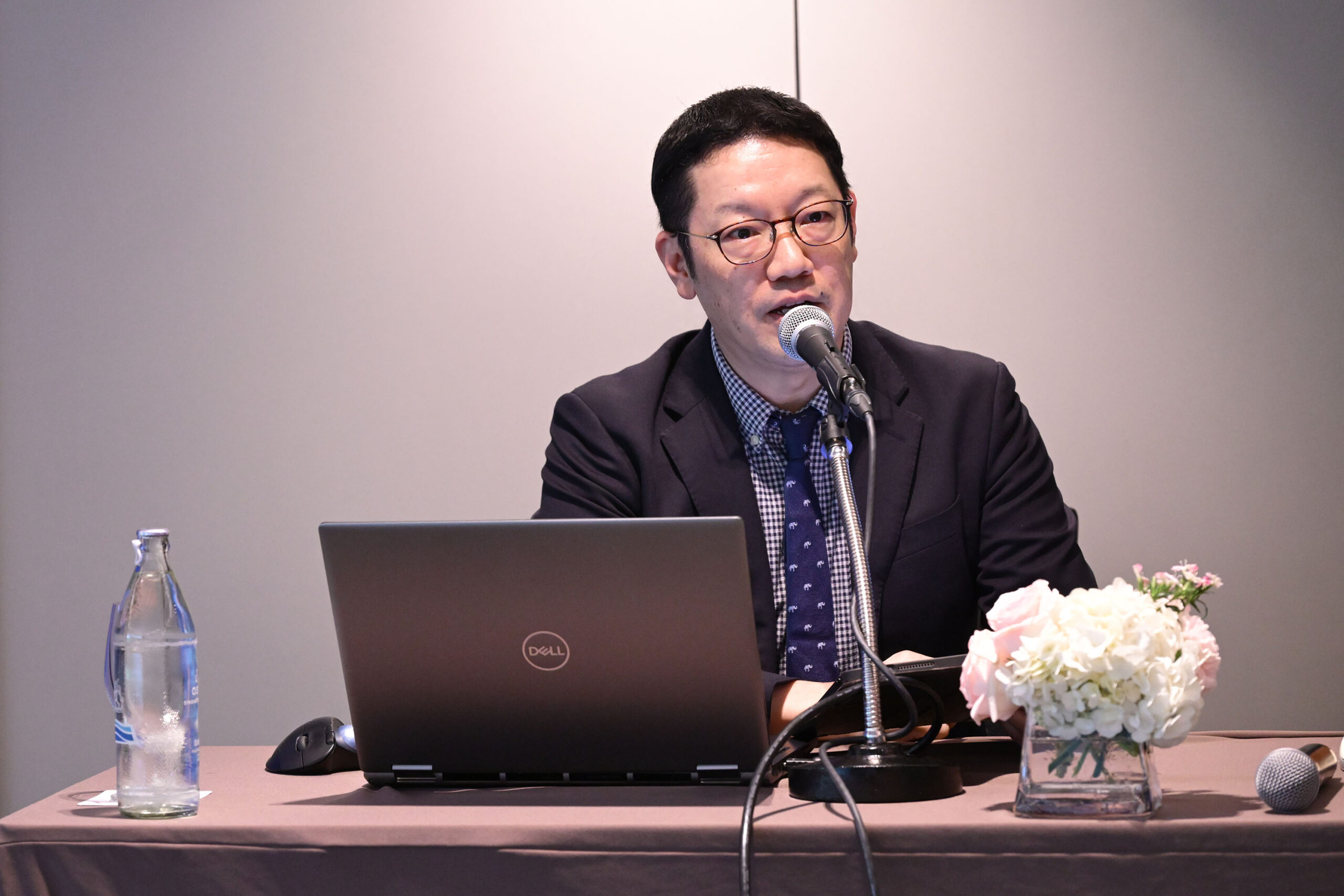
Mr. Tomita of EJEC is delivering his presentation at the seminar jointly hosted by JICA and the Department of Highways (DOH), Thailand.
Mr. Tomita of EJEC is delivering his presentation at the seminar jointly hosted by JICA and the Department of Highways (DOH), Thailand.
-

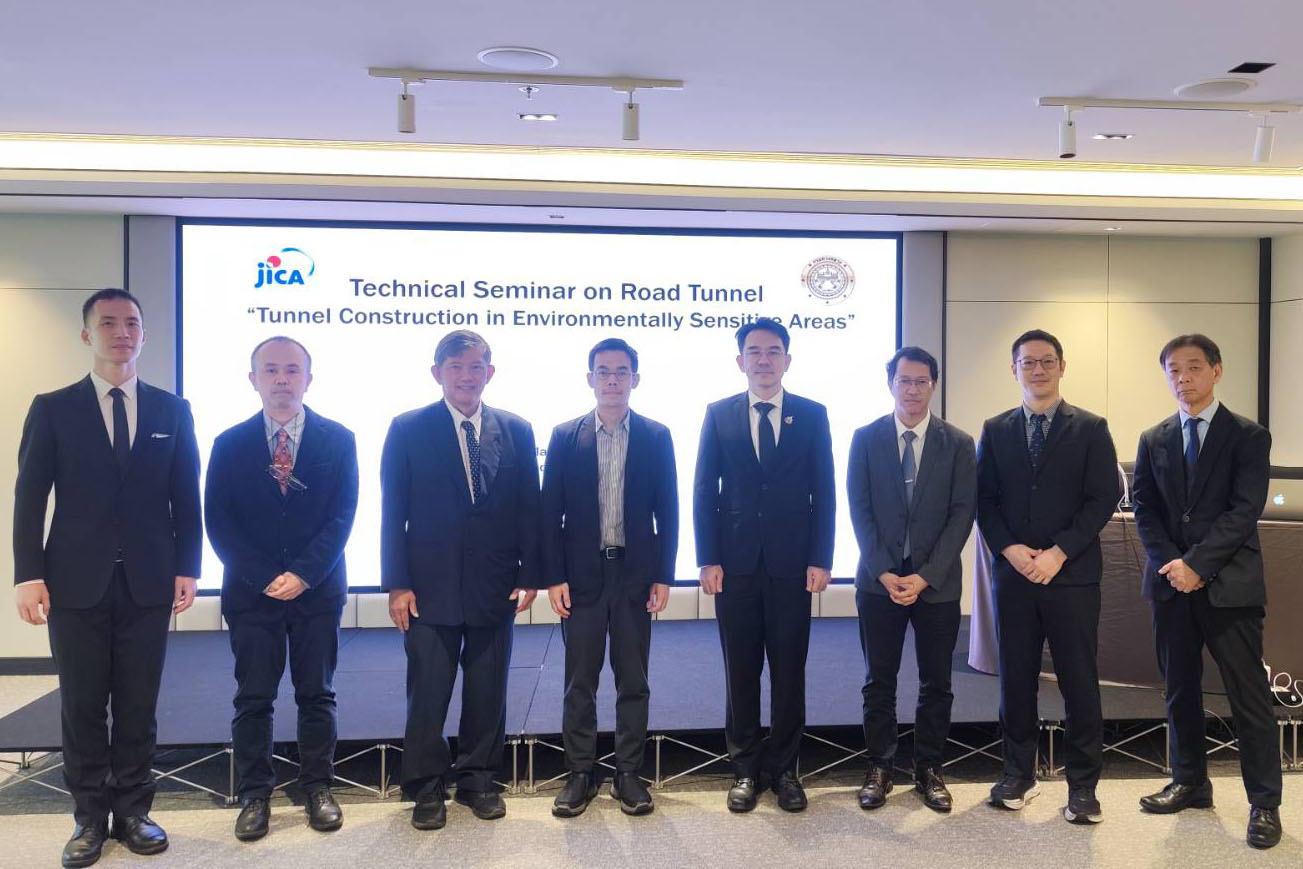
Group photo of speakers and participants, bringing together technical experts from JICA, the Thai Department of Highways, and both Japan and Thailand.
Group photo of speakers and participants, bringing together technical experts from JICA, the Thai Department of Highways, and both Japan and Thailand.
-
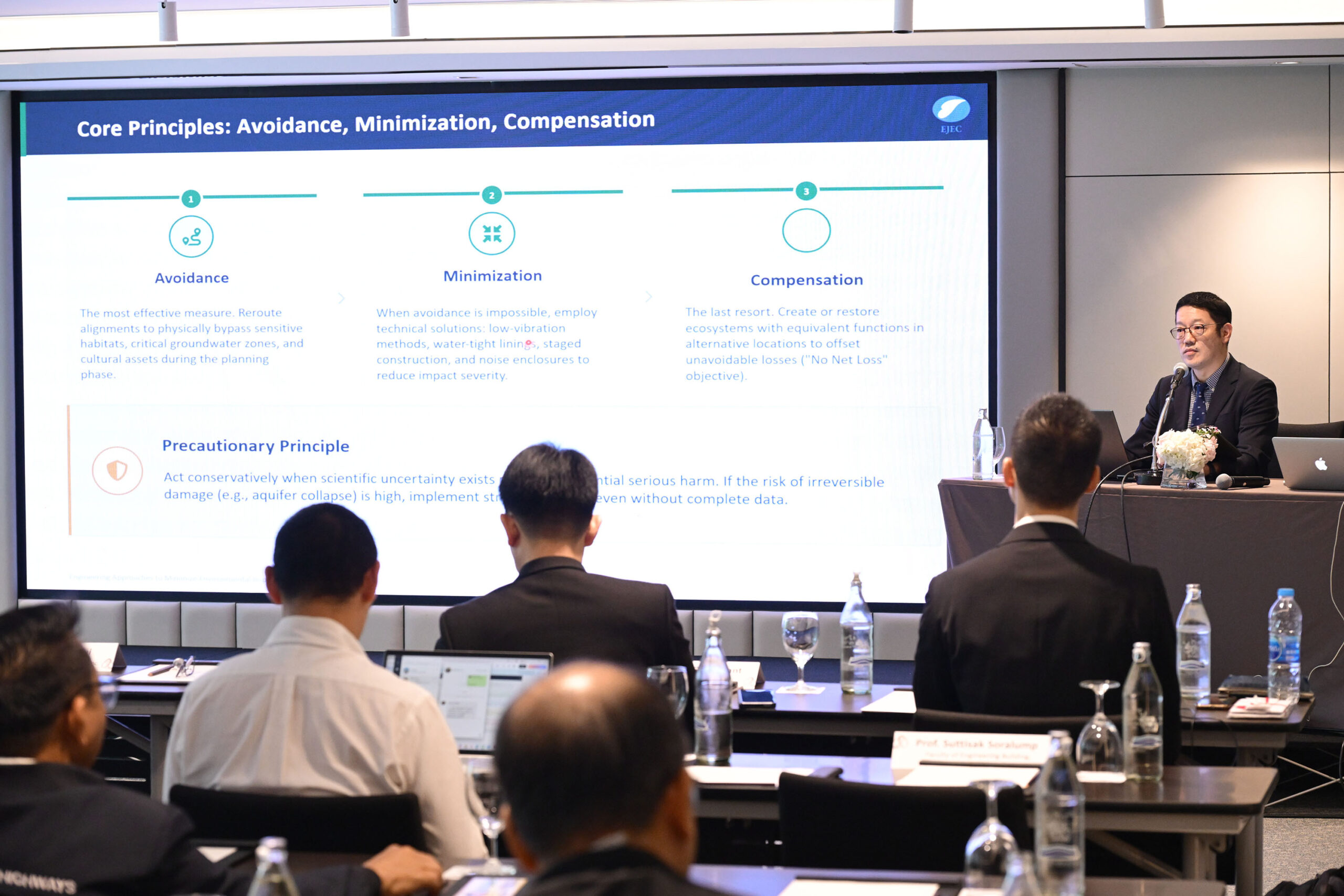
Scene from Mr. Tomita’s presentation. The screen displays the “Core Principles: Avoidance, Minimization, Compensation.”
Scene from Mr. Tomita’s presentation. The screen displays the “Core Principles: Avoidance, Minimization, Compensation.”
Outlook
This seminar served as a valuable platform for sharing Japan’s advanced expertise relevant to future roadway tunnel projects in Thailand that pass through protected regions. EJEC will continue contributing, both domestically and internationally, to achieving a sustainable balance between environmental conservation and infrastructure development.

 Eight-Japan Engineering Consultants Inc.
- All News
- Transportation & Road Infrastructure
- EJEC Delivers Invited Lecture at JICA’s First Road Tunnel Technology Seminar in Bangkok

 Eight-Japan Engineering Consultants Inc.